
Richard Feynman (1965)
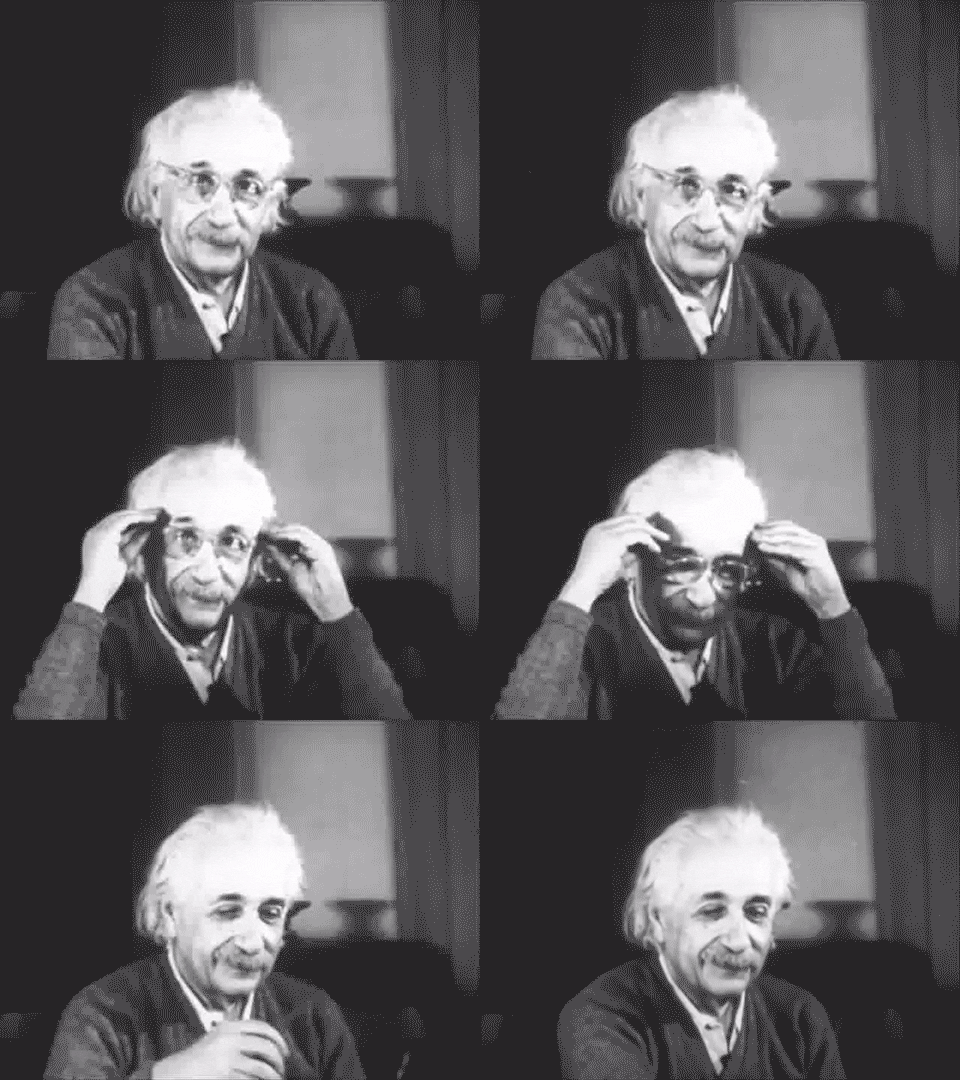
For the last 30 years of his life Albert Einstein worked on a theory to unify all the known forces. His belief in the simplicity and symmetry of nature convinced him that there had to be a common source for all forces. In 1905 and 1915 he had advanced Physics with his Special and General theories of Relativity using the right combination of imagination, intuition and non-conformity. His method was to use universal principles as a guide to deduce theories and predictions. Einstein used principles like the constancy of light’s speed, and the equivalence of gravity and acceleration, in thought experiments to develop his theories of relativity. At first Einstein only had to unify two forces; gravity and electromagnetic, but in the early 1930’s, the problem got more complicated with the discovery of two more Unification forces; the strong and weak nuclear forces.
Our senses are intended to help us get around and stay alive on the surface of the earth and are not ideal for gathering information for a theory involving the entire universe. We need to be humble and recognize the limitation of our senses and that our imagination is not as limitless as we would like to think. There is a strong tendency to think of everything in terms of human experience, there’s even a word for it; anthropocentric. We live in a very anthropocentric world.
An individual’s imagination is usually based on personal experience. Scientific study requires imagining beyond what are senses give us. All branches of science have aspects that challenge our ability to imagine them. Microbiology and Astronomy have seen great progress because of the technology that allows us to see beyond our stock senses. Imagining a bacteria or galaxy is much easier when you can see them.
Most people have difficulty imagining the very large and very small, very fast very slow, very hot, very cold. Scientists like to use analogies to put concepts in terms of the known and familiar. Large numbers of objects can be imagined by having them lined up and circle the globe, or reach to the moon and back. Physics is full of analogies; pool balls, balloons, Einstein used a railcar and embankment to visualize concepts in relativity, Newton started the spinning bucket of water debate that lasted centuries.
If our goal is to see the big picture we should try to avoid words like gargantuan, enormous, extreme, or worst of all, unimaginable. We can’t let something be mind boggling, unification will likely involve imagining something new and initially boggling. We need to recognize that the majority of the universe, its contents and mechanics lie outside everyone’s personal experience of velocity, mass, distance or temperature*.
*When considering the universal it helps to think in terms of orders of magnitude. The distance to farthest known object (quasar SDSS_1044_0125) is 2.4 x1026 m and the Planck length is 1.6 x10⁻³⁵ m, both hard to imagine. Our everyday experience lies roughly in the middle of the 61 orders of magnitude difference. The estimated mass of our Milky Way galaxy is 1.2 x1042 kg while an electron weighs 9.1×10⁻³¹ kg, a range of 73 orders of magnitude with personal experience, again roughly in the middle. Speed has an upper limit of 3×10⁸ m/s and something slow like the hour hand on a watch goes 3×10⁻⁵ m/s or tree ring growth at 1 x10-11 m/s.
 Towards Unification