
Of all the forces to be unified, we are the most familiar with gravity. We live our entire lives under gravity’s influence and in many ways it makes our world essentially two dimensional. Distances on the highway are measured in kilometres but elevations are in meters. To travel 900 kilometers is not remarkable. In the 1950’s if you needed to go 900 km you could go by plane, train, boat or automobile, but it wasn’t until October 1957 that we were able to build a machine able to go 900 km up and put Sputnik into orbit. Gravity limits the biosphere to a thin layer squashed against the surface of the planet. Except for fish and birds, gravity confines most of life’s activities to right down on the ground.
The fear of heights is essentially the fear of gravity. Einstein realized that when you are falling there is no gravity, so really it’s the absence of gravity that gives the sensation of falling. Our inner ear is very sensitive to small changes in gravity and variable gravity will make you sick. NASAs trains astronauts in a modified aircraft that dives to give periods of weightlessness. The plane is nicknamed the “vomit comet”. Most people are familiar with the feeling you can get on carnival rides or bumpy plane rides, in a boat it’s called seasickness, generally it’s called motion sickness.


People love to “defy the law of gravity” and daredevils like jumpers of bikes and skis try to travel as far as possible without touching the ground. One way gravity can be defied, or at least countered, is by centrifugal force:
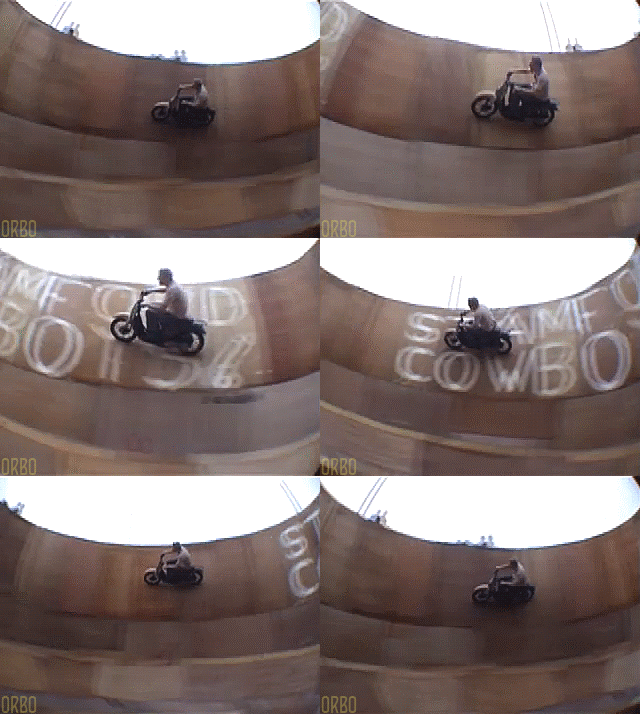


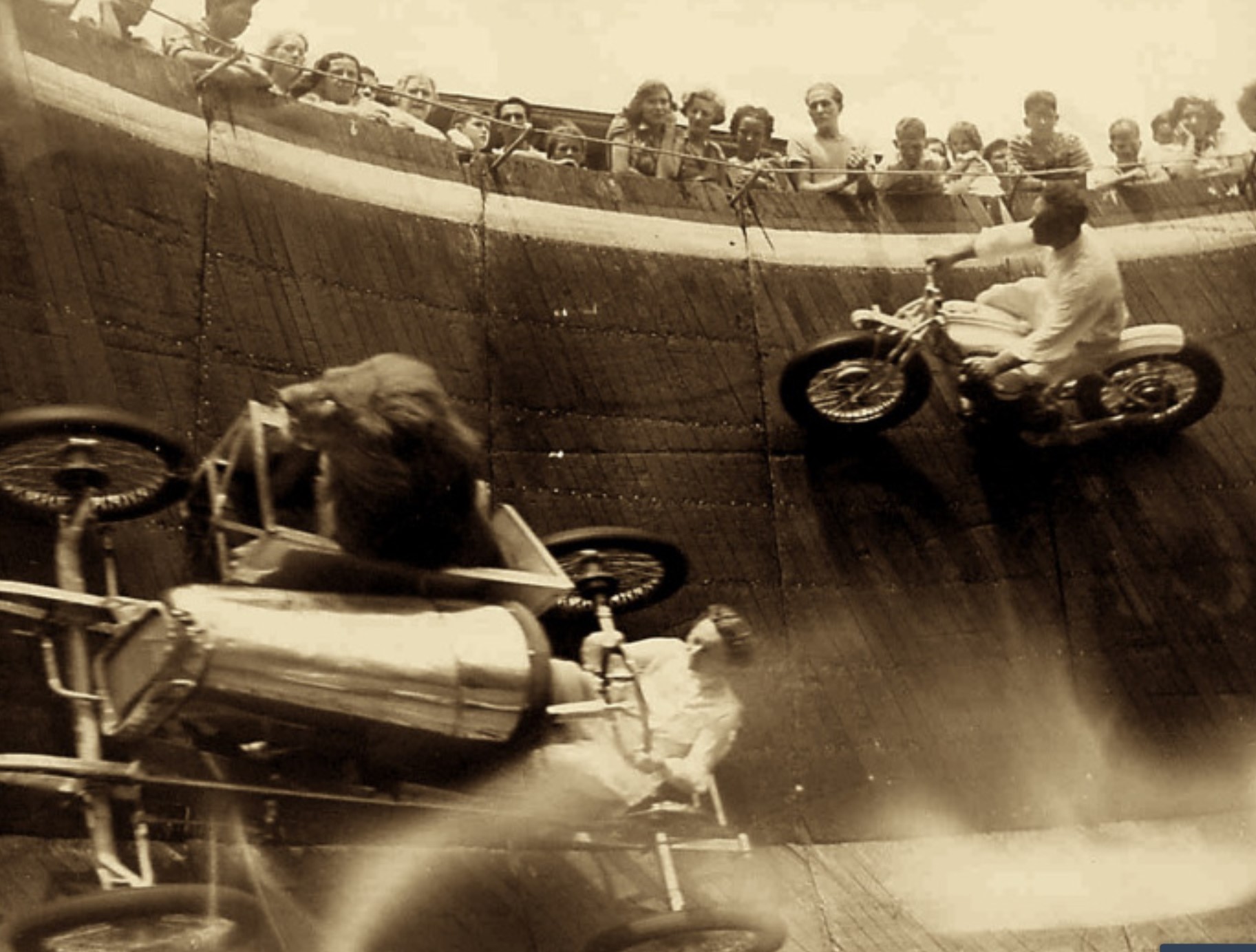
Gravity can be defied because circular motion results in acceleration that can counteract and balance gravity. In orbit the force from the circular motion counteracts the gravity, often called zero gravity, but more accurately the gravity is balanced.
The equation behind this gravity defying is:
a = V2 / r
For orbit: a = g
There are thousands of objects orbiting the earth, all of them going just fast enough to stay a fixed distance from the surface of the earth. Too slow and they would fall, going faster would lead to not just balancing but leaving earth orbit. Very few man-made objects have traveled beyond earth orbit and truly defied earth’s gravity.
Circular or curvilinear motion produces acceleration. In everyday use “acceleration” means an increase in speed, but the acceleration resulting from circular motion is obtained at a constant speed. The direction of the acceleration is at right angles, orthogonal, to the direction of the motion and towards the center of the curve. The acceleration results from the changing direction, not changing speed, of the velocity.
Einstein realized the equivalence of gravity and acceleration and uses some excellent analogies; a man in a room-sized box in space pulled by a rope equivalent to a gravitational field and clocks and measuring rods on the surface of a rotating disk equivalent to a gravitational field.
 Towards Unification