
Richard Feynman (1961)
Let’s form a postulate: Motion is universal, all matter has a velocity and the direction of this motion is curved. We know that curved motion results in acceleration as reviewed in the section on Gravity.
The goal of unification is to find a common source for the four Unification forces. For that to work, we need a common mechanism with a wide range of possible values. If we want to consider acceleration from curved motion as a candidate, it needs to meet this requirement.
For curved motion:
a = V2 / r
F = ma
Fc = m V2 / r
Where Fc is centrifugal force on the mass.
Thinking of the micro and macro universe there is a wide range of possible values for mass, radius, and Velocity to yield a wide range of forces, for example:
r radius: ranges from an atomic scale of approximately 10-15 m to the galactic scale of 1020 m for our Milky Way Galaxy
V velocity: from the hour hand on a watch, 3×10⁻⁵ m/s to the speed of light 3.0 x10⁸ m/s
m mass: an electron 9.1×10⁻³¹ kg to the Milky Way at 1.2 x1042 kg
Richard Feynman, (1985)
In the last 100 years huge advances have been made in physics at the atomic level. We can probe, measure, and predict with greater and greater accuracy. But we are still in the model and theory stage with no definitive picture of the true nature of the atom. In physics the two words particle and field are commonly used to label a wide range of undefined objects and behaviors.
The suggestion the atom and its parts have some kind of motion or spin is consistent with current models. (area for future study)
Symmetry suggests we should start looking for examples of the spiral or helical path in nature. You will find the helix at the very core of electromagnetism. Consider the creation of a magnetic field by running a current through a coil of wire or creating a current by moving a magnet through the coil (really any relative motion of a coil and a magnet). Area for future study
Light and electromagnetic radiation are often represented as a two-dimensional sine wave or, as shown below, perpendicular sinusoidal oscillations of electric and magnetic fields. 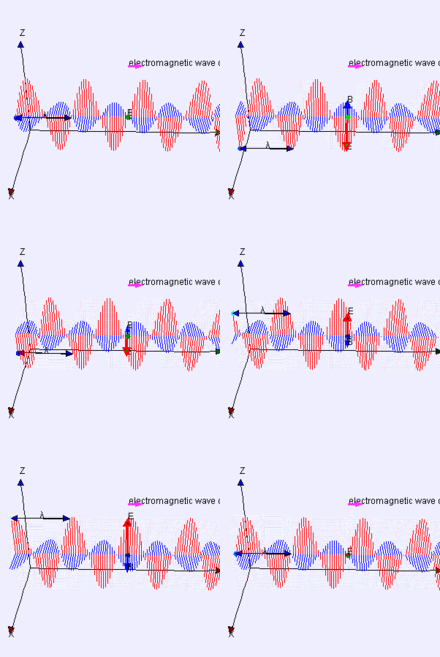
Let’s apply the universal motion concept to light and consider the true nature to be a helix in xyz and t. Picture a photon following a helical path. This is just the kind of a similarity you’d look for, or is it coincidental?
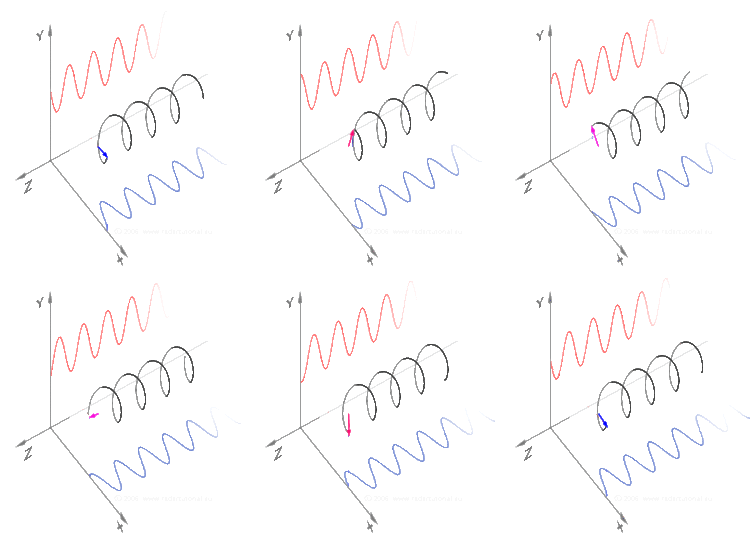
The projection or shadow of a helix gives the familiar 2d wave form used in current theories of light. How a helix, all or in part in the time dimension, would look and interact with our xyz dimensions as well as the sine/cosine geometry here is interesting.
 Towards Unification