
Albert Einstein, on the equivalence principle (1907)
In all the ways we can measure or calculate, gravity and acceleration are equivalent. The only thing preventing us from saying gravity is acceleration is the absurdity of saying the surface of the earth is accelerating up. However, history shows us that the once absurd notion that the earth is a giant globe spinning through space is true whether we can imagine it or not. We can be unaware of something profound on a large scale.
Science fiction icon Arthur C. Clark gave us two examples of spin used to “create” gravity. 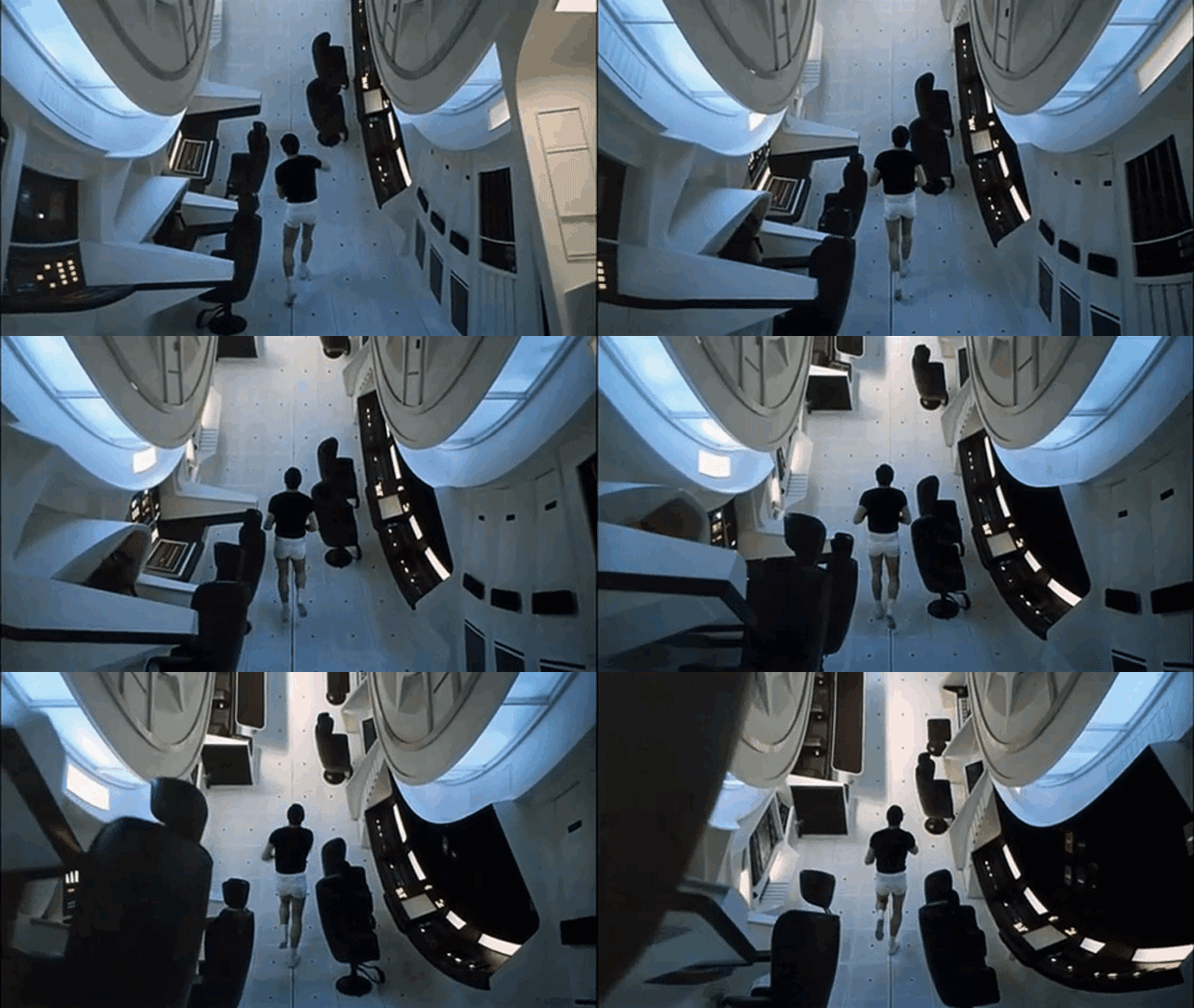 In 2001: A Space Odyssey, Clark imagines the space ship Discovery with a rotating ring that gives the crew enough gravity to sit, eat and even jog on their (ill fated) trip to Saturn/Jupiter*.
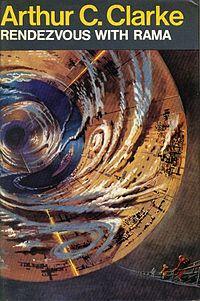
On a much larger scale, in Rendezvous with Rama, Clarke has us imagine a rotating cylindrical space ship 50 kilometres long and 16 km in diameter. Spinning at 1/4 rpm gives around 1/2 g at the surface, enough to support a sea on the circumference. Explorers enter the ship at the pole where there is no gravity and descend on ladders, the gravity increasing as they approach the inside surface.
Clarke’s “fake” gravity is indistinguishable from earth’s gravity. You would think that the “pull” of gravity from the mass of the earth would be different than the “push” up from the floor of a spinning shell.
In the famous experiment performed on the moon, a feather and a hammer are observed to 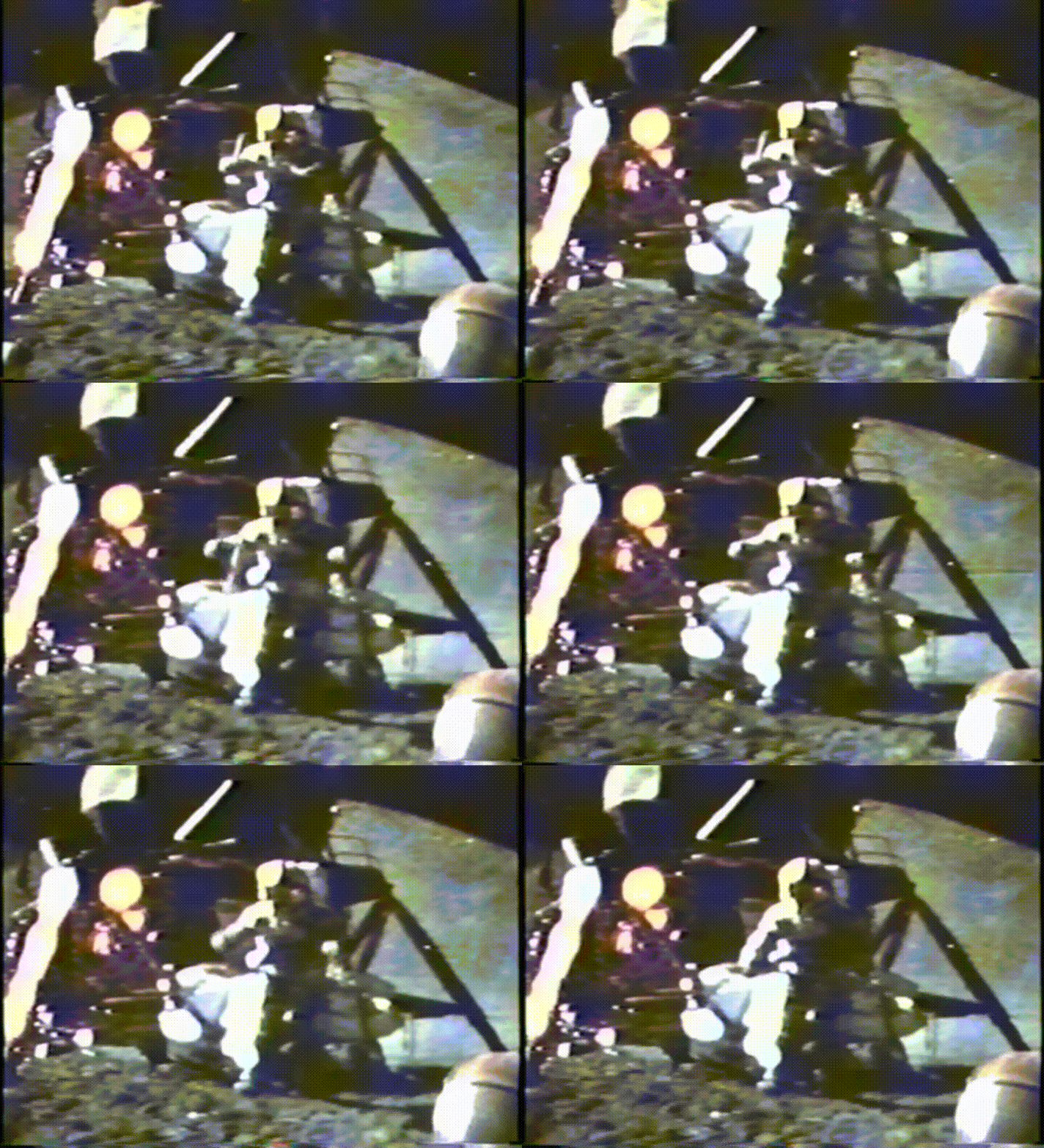 fall at the same rate in a vacuum. The convention here is that the moon’s gravity pulls harder on the larger mass of the hammer than the feather to give the same acceleration.
If gravity “pulled” on a dropped object there would be a measurable force of acceleration as measured by an accelerometer. There are accelerometer apps that let you try this at home with your phone. You will find that a falling body experiences no measurable “pull”.
Imagine it’s the other way around, that gravity is pushing up. The surface of the moon is accelerating up to meet the feather and hammer, this would account for both the identical speed and lack of a measurable force.
What makes it difficult to imagine earth’s gravity as spinning acceleration is that the force is outward on the outside of a globe, not the inside of a spinning cylinder. Because the acceleration is from circular motion, opposite sides of the Earth can accelerate in opposite directions but remain the same distance apart. The same way that the walls of a spinning cylinder, like a bucket, accelerate towards each other, but stay the same distance apart.
As the acceleration is at right angles to the direction of spin, we would need a direction of spin at right angles to gravity. Gravity is in all directions so we need another dimension that is at right angles to all familiar x, y and z. From part X we know that time meets this requirement. We can use the dimension of time as the direction of the motion. We know that gravity is related to the curvature of space time. It’s a small step to conclude gravity is acceleration and comes from curved motion in space time.
* In the book “2001: A Space Odyssey” the destination is Saturn, in the movie and subsequent sequels, the Discovery goes to Jupiter.
 Towards Unification