
If we look for something that could be considered a universal attribute or characteristic, the sphere is a good candidate. The Hubble telescope lets us see large numbers of spherical stars in all directions. Each star is thought to be orbited by a number of spherical planets. Spheres occur frequently in nature and we visualize atoms as spherical. The sphere is symmetrical. You could say the sphere is a universal shape.
Let’s consider one less obvious characteristic of the known universe: motion. From the micro to macro everything is moving, velocity is universal. Keep in mind that Velocity is a vector with both speed and direction.
An object on the table, that appears to be at rest, travels at the speed and direction of:
Rotation of earth (on equator) 4.7×10² meters/second
Earth orbiting the sun 3.0 x10⁴ m/s
Sun orbiting in the Milky Way galaxy 2.0 x10⁵ m/s
Our galaxy relative to background radiation 5.5 x10⁵ m/s
The speed of light, C is 3 x10⁸m/s, if we guessed that an object on a table is at rest (V=0) we are wrong by 5 orders of magnitude. The object is only 3 orders of magnitude from travelling at the speed of light1.
Consider any object on the surface of the earth and imagine the net direction and speed vectors of all known xyz velocities and we realize that our object “at rest” on the table is travelling at great speed along a curved path in space. 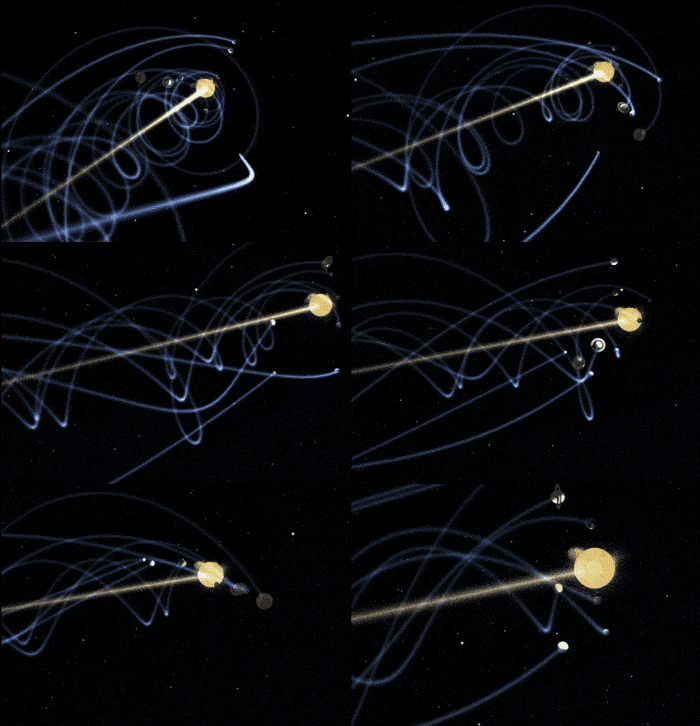 The path of an object on Earths surface is spiralling or helical, in fact multiple helices or super helices.
A spiral is generally a two dimension curve with a changing radius, the spiral turns up frequently in nature in snails, flowers, pinecones etc2. A helix is a curve in 3-dimensional space with constant radius.
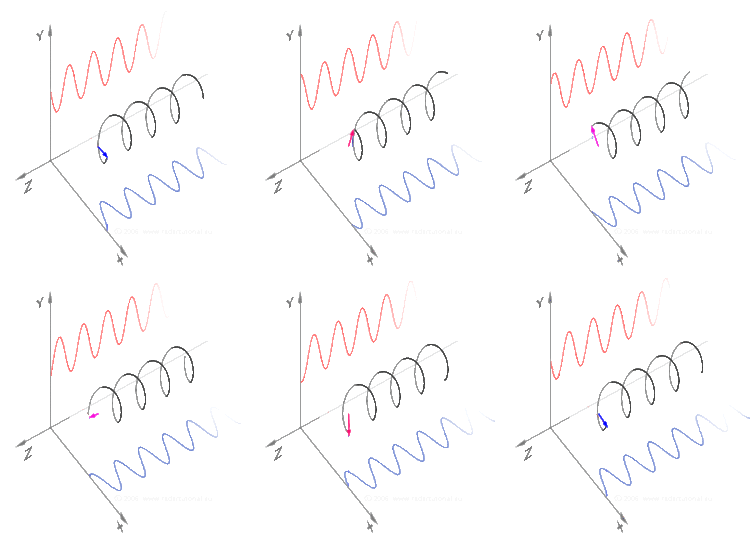
x = cos(t), y = sin(t), z = t
A left handed helix results from making any term negative and is chiral, no amount of rotation or translation can make a left-handed helix appear as a right-handed helix. The 2D projection or shadow of the helix is a sine wave with the x and y projections offset by 90° or π/2
When you start looking for other examples of the helix in nature you find spirals and helices everywhere, from atomic particles to DNA to spiral galaxies3. Spirals and helices could be considered a universal shape. A natural similarity over 35 orders of magnitude is the kind of symmetry we’re looking for and what you’d expect to find in a unification theory.





1 Three orders of magnitude is easy to imagine, it’s the difference between a second and an hour or a gram and a kilogram, a meter and a kilometer.
2 Often the radius of natural spirals changes according to the Fibonacci sequence (0,1,1,2,3,5,8,13,21,34…).
3 Helical objects have interesting properties, often as a result of the shape. Think of a Slinky, springs, spiral staircases, threaded fasteners, boat and airplane propellers.
 Towards Unification